
A consulting team wanted to find the people who run specific companies in a specific region of Switzerland: who leads the company, who leads finance, and where the information comes from. Normally, that's a list someone builds by hand. I used this as test case for an AI-training session with the team and solved the same job three ways, with ChatGPT and Codex. Note: I'm still not a software engineer... ;-)
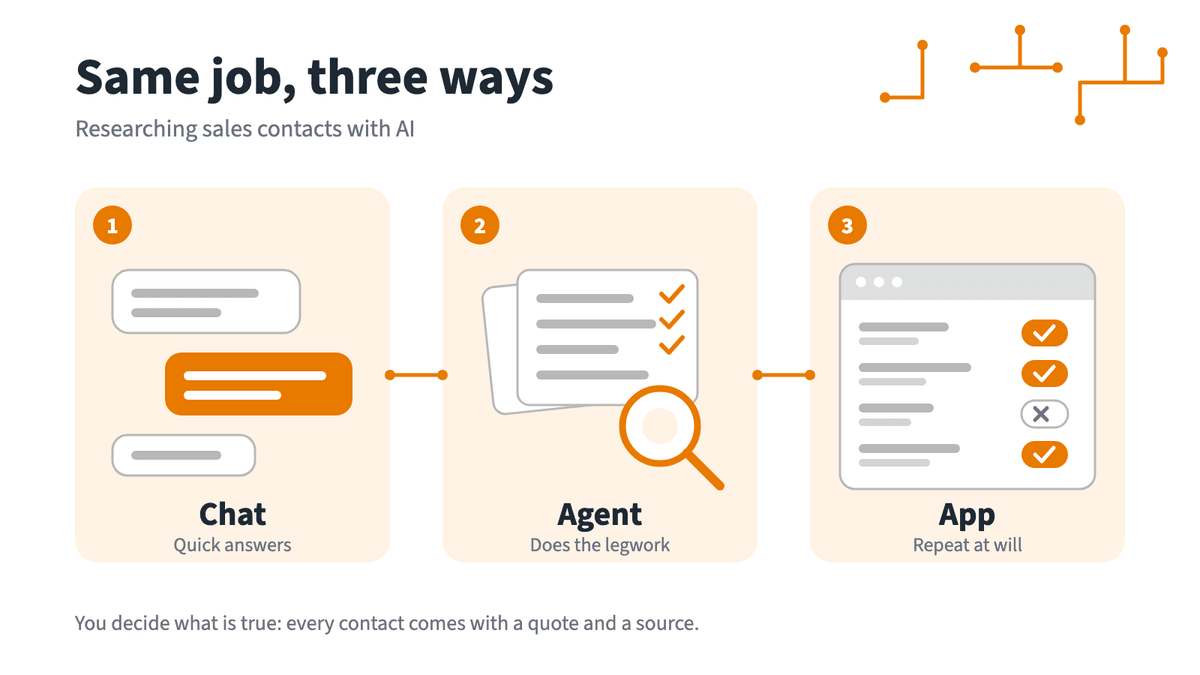
STEP ONE: THE CHAT
I started with ChatGPT. I explained the task in plain language, pointed it to a public member list, and set a few ground rules: only report what can be verified, give a source link and a short quote for every person, and say "not found" instead of guessing. After some back and forth, I asked for the result as a list I could export. It's quick to start and great for a handful of companies. With dozens of companies, it easily turns into a lot of more back and forth in the chat dialogue.
STEP TWO: THE AGENT
Then I gave the same brief to Codex, an agent that works in a project folder on my computer. Same rules, same goal, but now it does the legwork itself: it reads the list, visits the company websites, and saves its findings as files. I asked for a plan first, tested with a few companies, and let it continue once the first results looked right.
STEP THREE: THE APP
Finally, I asked Codex to turn the whole process into a small web app that runs on my own computer. I described what I wanted, not how to build it. Then I tried it, looked at the results, and gave feedback in plain sentences until it did what I needed: list the companies, find the people with their sources, and let me approve or reject each finding before anything is exported. I did not write code. I wrote feedback.
WHAT TO WATCH FOR
In all three versions, the same things need a human eye: roles that sound right but aren't (a mayor is not a managing director), companies that repeat the people of their parent group, information that is out of date, and e-mail addresses that look plausible but were never published. Guessed addresses are a bad idea, technically and legally. A quote and a source next to every name makes checking fast.
The chat is for a quick answer, the agent is for the legwork, the app is for doing it again next month.
FINAL VERDICT
The AI finds, the human decides. Which tool fits depends less on intelligence and more on how often you need the result.
P.S. The same brief also went to Claude Chat and Claude Code. Different tools, same findings.