
Something has been showing up repeatedly in the Swiss job market over the past several months: a new kind of role, built around AI, appearing at organizations that otherwise have nothing in common. A global sports federation, a private bank, an energy utility, a cantonal government office, a law firm, a media company, an industrial group, an insurer. Different sectors, different cities, different HR teams, no coordination between any of them. I got curious enough to dig in properly.
THE ARCHETYPES, AND HOW I GOT THERE
The method was simple. I pulled ten real job postings, all titled something like AI Governance Manager, AI Transformation Lead, or AI Adoption and Enablement Manager, and read them side by side instead of one at a time. With the help of my AI assistant Claude analysing the data, three clusters emerged almost immediately.
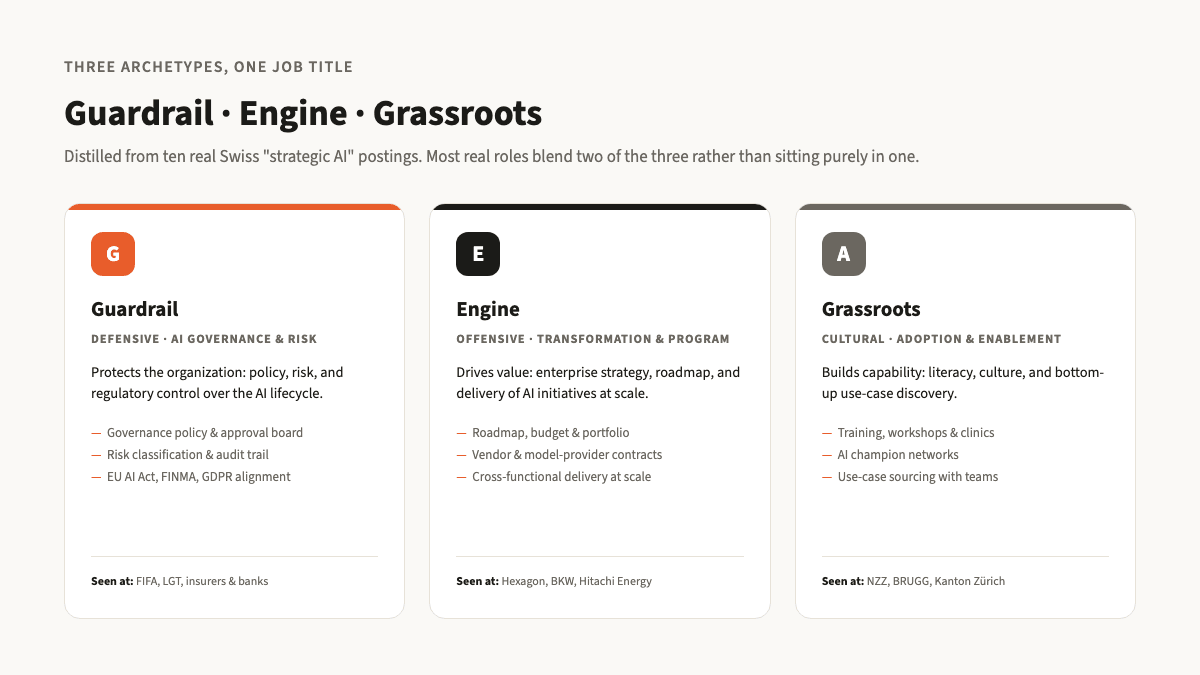
The first is what we call the Guardrail. This is AI governance, risk, and compliance work: writing the policies, chairing the approval board, keeping an auditable inventory of every AI system in use, translating the EU AI Act and FINMA's expectations into internal controls. It is a defensive function, and it shows up hardest in regulated or international organizations, often as a senior individual-contributor role rather than a people-management one.
The second is the Engine. This is AI transformation and program leadership: owning the enterprise roadmap and budget, prioritizing use cases across the business, negotiating vendor and model-provider contracts, leading delivery teams to get pilots into production. It is an offensive function, usually the most senior of the three, and it looks a great deal like the "digital transformation lead" role that was everywhere five years ago, just pointed at a new technology.
The third is what we call Grassroots. This is AI adoption and enablement: running workshops, building a network of AI champions across departments, raising literacy among people who will never write a prompt-engineering guide but need to use these tools responsibly. It is the most people-facing of the three, usually mid-level, and it is the one most directly connected to an obligation already in force, since the EU AI Act's Article 4 requires providers and deployers to support their staff's AI literacy.
None of the ten postings we read was ever purely one archetype. Most leaned heavily toward one while borrowing a little from another; a couple sat almost exactly between two. That blending turned out to matter as much as the archetypes themselves, and it is the detail that shaped the tool Claude and me ended up building.
Claude (reviewed by ChatGPT) checked the pattern against outside data too. Switzerland still has no overarching AI Act of its own, while the EU AI Act can already reach Swiss companies with relevant EU activities, with important high-risk obligations still coming into force in 2027 and 2028. FINMA's December 2024 guidance provides another regulatory backdrop, particularly for governance roles in Swiss finance. On the market side, PwC's 2026 AI Jobs Barometer found Swiss AI-related postings at a record high in 2025, even though they still represented just 1.8 percent of the overall market. The jobs.ch AI Report 2026 points in the same broader direction: AI exposure is spreading well beyond traditional tech roles.
Put together, the pattern looks less like a handful of fashionable job titles and more like company org charts catching up to a technology that arrived faster than the job architecture around it, in three distinct shapes: control, delivery, and culture. With important high-risk AI obligations still coming into force in late 2027 and 2028, I would be surprised if this hiring pattern slowed down soon.
THE WEB APP THAT CAME OUT OF IT
Spotting a pattern across ten PDFs is one thing. Making it useful to someone else is another, so I let Claude Code built an web app around it: the AI Jobs Profiler.
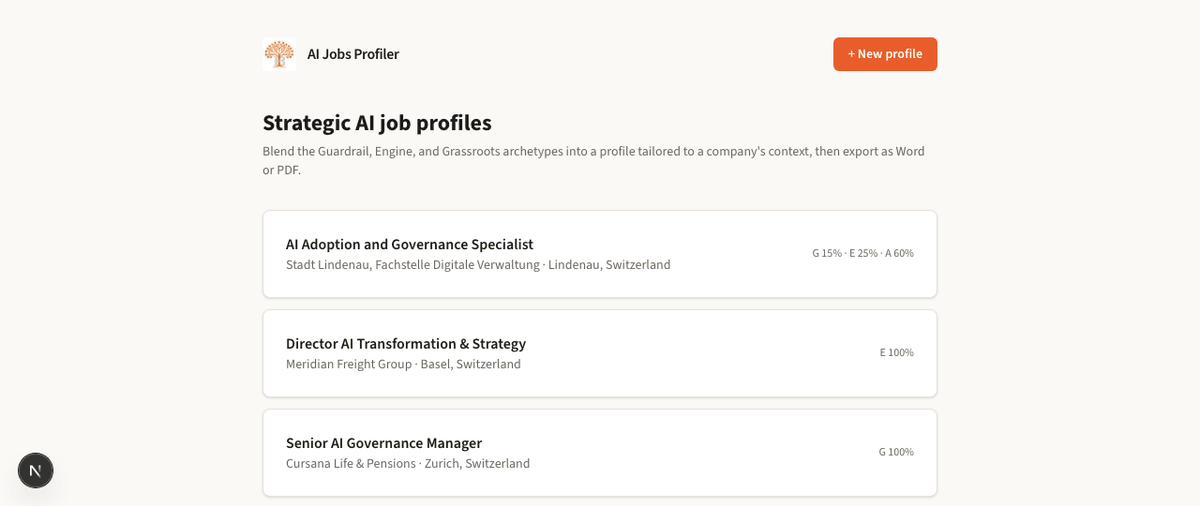
The idea is straightforward. Instead of writing a strategic AI job profile from a blank page, you describe the company and the role in plain terms: industry, size, regulatory exposure, reporting line, whatever you know. The app then walks you through a short set of yes, no, or don't know questions about what the role actually needs to do: chair a governance board, own a budget and roadmap, run literacy workshops, and so on. Based on your company context, it proposes an answer to each question before you even touch it, with a short plain-language reason for every suggestion, which you can accept or overturn field by field.
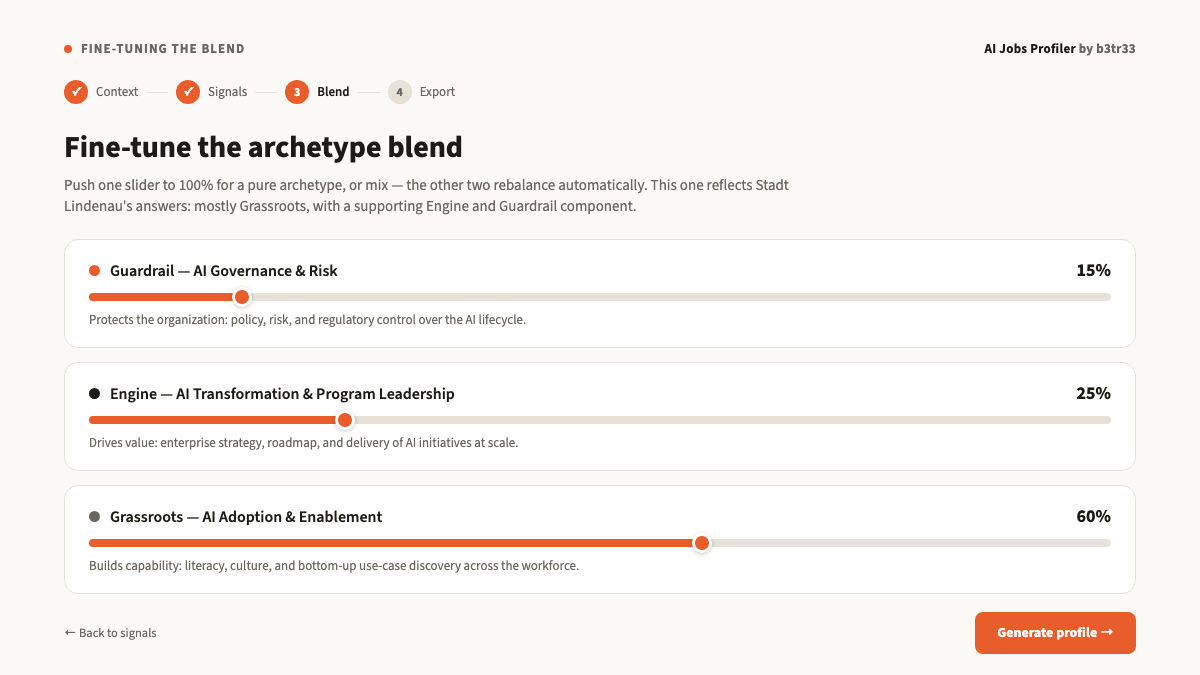
Those answers feed directly into a blend across the three archetypes: Guardrail, Engine, and Grassroots, shown as three adjustable sliders that always sum to a hundred percent. Push one to a hundred for a pure archetype, or leave a genuine mix, exactly as most of the real postings we studied actually were. That blend, together with your company context, is handed to an AI model along with the pattern library distilled from the ten original postings and a short grounding note on the current Swiss and EU regulatory backdrop, so the result reads as one coherent role rather than three templates stapled together.
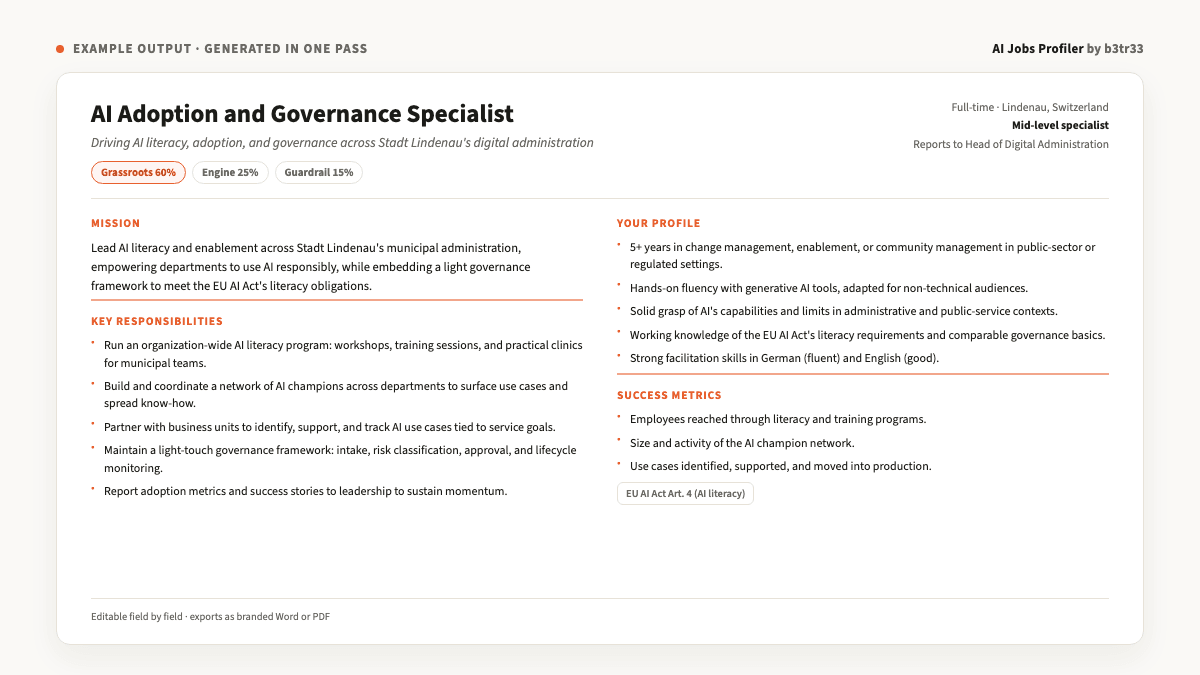
The output is a full job profile: title, mission, responsibilities, required profile, success metrics, and the regulatory frameworks that are actually relevant to that company, not a generic list. Every field is directly editable before you are done, and the whole thing exports as a branded Word document or PDF, ready to hand to HR, a hiring manager, or a client
I let build it because I kept noticing the same three shapes over and over while digging into these postings, and because writing a genuinely tailored strategic AI job profile from scratch, one that actually reflects a specific company's regulatory exposure and AI maturity rather than reusing boilerplate, takes real effort every time. This tool does not replace that judgment. It gives you a grounded first draft in minutes, built from what ten real Swiss postings and the regulatory calendar actually say these roles need to do, so you can spend your time refining it instead of staring at a blank page.
If you are hiring for one of these roles, or trying to figure out which one you actually are, I would be curious to hear whether the three archetypes match what you are seeing too.
Appendix: Used technologies in the web app
Under the hood it is a small Next.js and TypeScript app, styled with Tailwind CSS and Source Sans 3 to match this site's own look. The generation itself runs through the OpenAI API, with the archetype pattern library and the Swiss regulatory notes built directly into the prompt rather than left for the model to guess. Word exports are built with the docx library and PDFs with React-PDF, both reading from the same profile data so the two stay in sync, and everything is stored as plain local files, no database required.